
Thinking About LLMs for Your Business? Here’s How to Decide What’s Right for You
Unlocking AI Potential: A Practical Guide for Small and Mid-Sized Tech Companies to Get the Most Out of Large Language Models (LLMs)

Are you weighing the decision to invest in Large Language Models (LLMs)? How much should you budget? Which tech stack will serve you best? Do you really need to hire more engineers to pull it off? And the big question: should you build custom models or leverage prebuilt solutions? These are the questions every small and mid-sized business needs to ask before diving into AI. The right answers can save you time, money, and resources—while supercharging your data engineering capabilities.
Let’s break down the options and find the best fit for your business!
1. Understanding LLMs and Their Potential
Large Language Models (LLMs) have become buzzwords in tech, but their potential goes far beyond just hype. LLMs can be leveraged to enhance customer service, automate content generation, extract valuable insights from unstructured data, and improve internal operations. For small and medium-sized companies, the right LLM can mean a significant competitive edge—but only if implemented strategically.
At its core, an LLM is a type of AI model trained to understand and generate human-like text. Popular examples like OpenAI’s GPT, Google’s PaLM, Google’s BERT and Meta’s LLaMA, Anthropic’s Claude, xAI’s Grok have revolutionized how businesses approach customer support, content creation, and data analysis. But while LLMs can unlock efficiencies, they’re not a one-size-fits-all solution. Depending on your business’s size, budget, data, and team maturity, the approach you take will significantly impact your return on investment (ROI).
2. Identify Your Business Needs: What Do You Want LLMs to Do?
“The goal is not just to use AI for AI’s sake. It’s about solving real problems and delivering business value.” — Sundar Pichai, CEO of Google
Before deciding to adopt LLMs, the first step is to clearly outline the business challenges you aim to solve. Whether it’s automating customer interactions, generating marketing content, or analyzing large datasets, LLMs can offer numerous solutions, but they should address a specific need in your operations.
Some common use cases for LLMs include:
• Natural Language Processing (NLP) for Chatbots and Customer Support: LLMs can enhance customer interactions through intelligent automation that reduces human intervention.
• Content Generation: From writing marketing copy to creating technical documentation, LLMs can help streamline the content creation process.
• Data Analysis and Reporting: LLMs can help you analyze and summarize large volumes of data to generate insights faster than traditional methods.
By defining your goals upfront, you can avoid wasting resources on capabilities that don’t align with your strategic objectives.
The Build vs. Buy Dilemma: Custom Model or Prebuilt Solution
“Building AI is like constructing a power plant. You can either buy the electricity or build your own source. The choice depends on how much control and customization you need.” — Andrew Ng, AI Pioneer
When considering LLMs, the first major decision is whether to build your own custom model or use a prebuilt solution. Both options come with their own advantages and challenges, and the right choice depends on your specific business needs.
Custom LLMs are tailored to your unique requirements, trained on proprietary data, and can offer a competitive edge with highly specialized functionality. For instance, if your industry relies on understanding niche jargon, analyzing proprietary data, or performing tasks beyond the capabilities of off-the-shelf models, a custom LLM may be the best fit. However, building custom models requires substantial resources, including compute power, data engineering expertise, and ongoing maintenance. The upfront investment in time and money can be significant, and you’ll need a skilled team to develop and support the model.
On the other hand, prebuilt LLMs—offered by providers like OpenAI, Google, and Cohere—are a quicker, more economical option. These models come ready to use with plug-and-play capabilities, making them ideal for small and medium-sized businesses that want to leverage AI without investing heavily in infrastructure or hiring a specialized AI team. Prebuilt LLMs are typically available via subscription or pay-as-you-go pricing, allowing you to scale usage based on your needs. This flexibility makes prebuilt solutions particularly attractive for tasks like improving customer support or generating marketing content, where your requirements are more general.
To decide which path to take, evaluate your specific business use cases. If you need to automate standard processes, improve customer interactions, or generate content, prebuilt models will likely serve you well. They allow you to get started quickly and affordably, with costs primarily tied to usage. For businesses with more specialized needs or long-term goals involving proprietary data, a custom LLM might justify the investment down the road.
A good strategy for small to mid-sized companies is to start with prebuilt solutions to minimize risk and monitor ROI. As your needs grow, and if off-the-shelf models no longer meet your requirements, transitioning to a custom LLM could become a necessary part of your growth strategy.
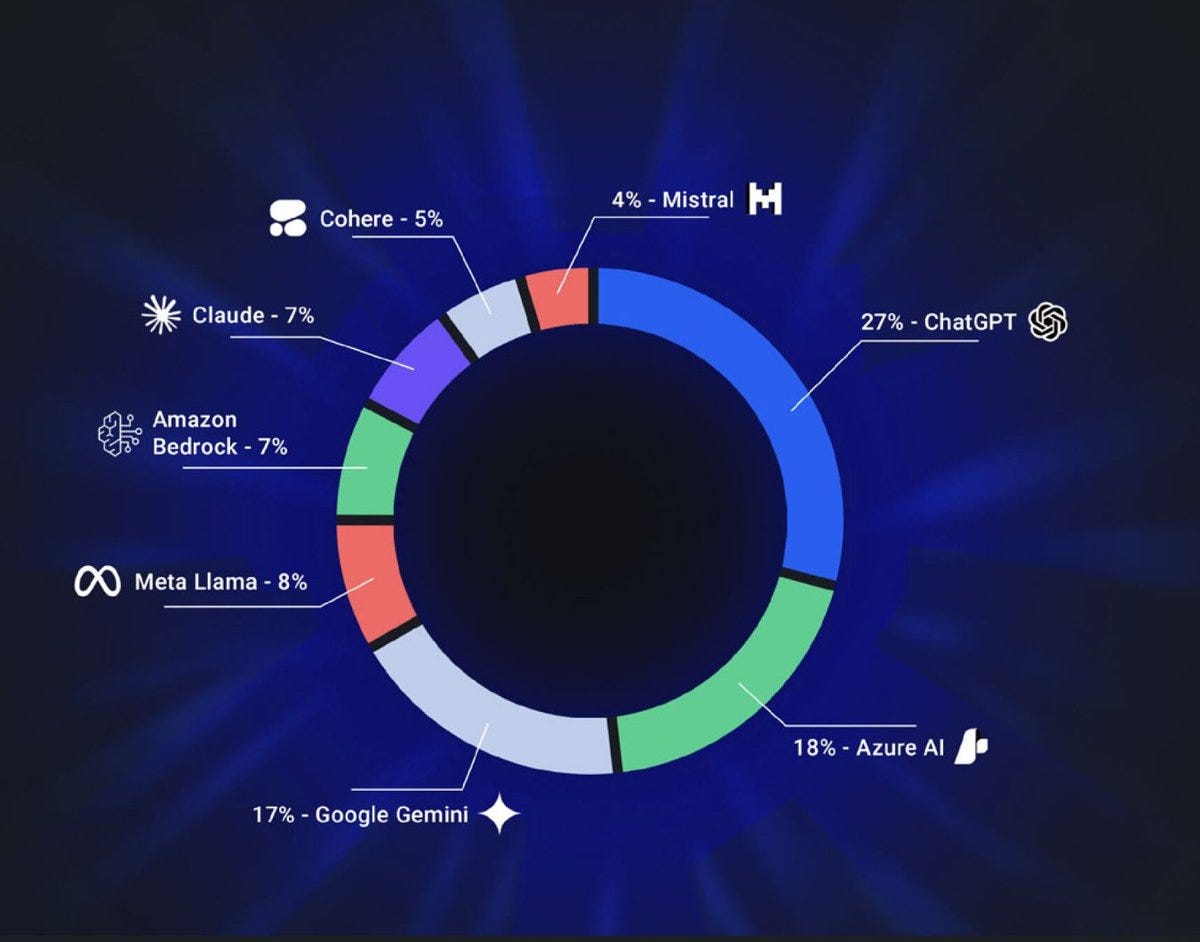
Survey results of nearly 800 enterprise folks on LLM market share (run by Kong). Here are the results:
Do You Need to Hire More Engineers?
For most businesses, the decision to hire more engineers depends on the level of customization you’re aiming for. Prebuilt LLM solutions are relatively easy to integrate with existing tech stacks and usually don’t require a full-time AI team for maintenance. Your current engineers can manage the integration and ongoing operations with minimal disruption.
If you’re planning to build and fine-tune custom models, however, you’ll need a dedicated team of machine learning engineers, data scientists, and AI specialists. This often means expanding your team—or investing heavily in training existing team members—to build and maintain the necessary pipelines and infrastructure. It’s crucial to ask yourself: is this an area where you want to expand your workforce, or would it make more sense to leverage external services?
5. Choosing the Right Tech Stack
Your tech stack should align with the LLM solution you choose. If you’re leveraging prebuilt models, most LLM providers offer APIs that integrate seamlessly into popular cloud platforms like AWS, Google Cloud, or Microsoft Azure. This means you won’t need to overhaul your current infrastructure. Cloud-based LLM APIs offer scalability, reliability, and ease of use.
For custom LLM development, you’ll need more advanced infrastructure, including:
• Cloud Compute: Training LLMs from scratch requires significant computational power, especially if you’re dealing with large datasets. Cloud providers like AWS Sagemaker, Google Cloud AI, or Azure Machine Learning provide scalable compute resources for this purpose.
• Programming Frameworks: Python is the dominant language for LLM development, supported by frameworks like Hugging Face’s Transformers library, TensorFlow, and PyTorch.
• Data Pipelines: Efficient data storage and processing pipelines are crucial for training and deploying LLMs. Solutions like Amazon S3 or Google Cloud Storage can support the large volumes of data needed for custom LLM models.
Choosing the right stack will depend on your need for flexibility (custom solutions) versus simplicity (prebuilt solutions).
Budgeting for AI: Comparing the Costs of Custom LLMs vs. Prebuilt Solutions
When considering the costs between building custom LLMs and using prebuilt solutions, the financial investment can differ dramatically. Prebuilt LLM solutions, such as those from OpenAI (GPT-4) or Google Cloud (PaLM), typically operate on a pay-as-you-go model. Costs are based on usage, such as the number of API calls or tokens processed. This makes prebuilt solutions an affordable and scalable option, with pricing starting as low as a few cents per query, making it ideal for small to mid-sized businesses that need fast implementation without upfront infrastructure or engineering costs.
On the other hand, building custom LLMs requires a significantly higher investment. Costs include hiring machine learning engineers, securing cloud infrastructure (for training and deploying models), and acquiring vast datasets for training. This process can run into the hundreds of thousands of dollars, depending on the scale and complexity of the model. Ongoing maintenance, fine-tuning, and updates also add to the long-term expenses. While custom models offer more flexibility and control, they’re best suited for businesses with unique needs or proprietary data that require highly specialized solutions.
For most businesses, starting with prebuilt solutions offers the most cost-effective entry into leveraging LLMs.
When to Go All In—And When to Wait
Not every business is ready to adopt LLMs, and that’s okay. If you have well-defined processes that could be automated or augmented by AI—for instance, if you’re already collecting valuable data and need a better way to derive insights—then it may be time to explore LLMs.
But if your business is still struggling with basic data infrastructure, implementing a sophisticated AI solution may be premature. LLMs thrive on high-quality, well-organized data, so if your data isn’t ready, your LLM won’t be either. In this scenario, it might be wiser to first invest in getting your data pipeline and infrastructure in order before exploring advanced AI.
The Final Takeaway
Ultimately, the decision to implement LLMs is about aligning capabilities with needs. The best choice for your business depends on your goals, your available resources, and your appetite for innovation. Prebuilt LLMs offer a cost-effective, lower-risk entry into AI that can provide immediate value, while custom solutions deliver long-term competitive advantages but at a higher cost.
As a decision-maker, it’s essential to think strategically about what your business actually needs. The right LLM can provide a remarkable boost—but it’s not about chasing the latest shiny technology. It’s about understanding your core challenges and choosing the solution that best addresses them.
“AI will redefine industries and transform business processes, but it’s the execution of AI strategy that separates the winners from the rest.” — Satya Nadella, CEO of Microsoft
Ready to embark on your AI journey? Subscribe to our newsletter for more insights and strategies to stay ahead in the tech industry. Let’s transform your business together!